Vision and support surface in postural sway
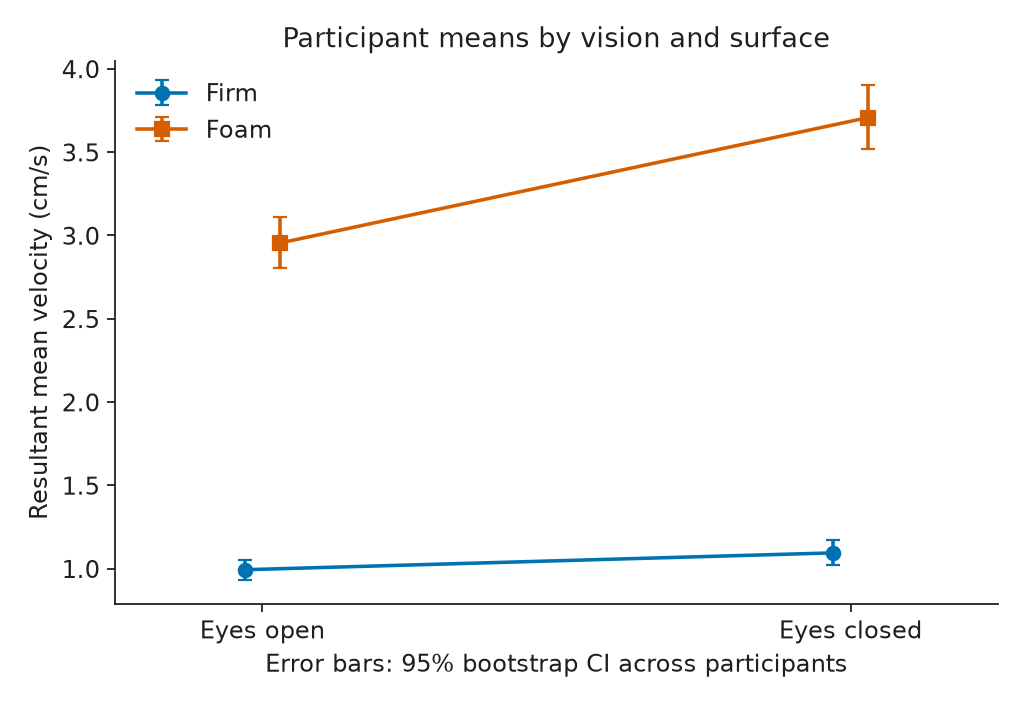
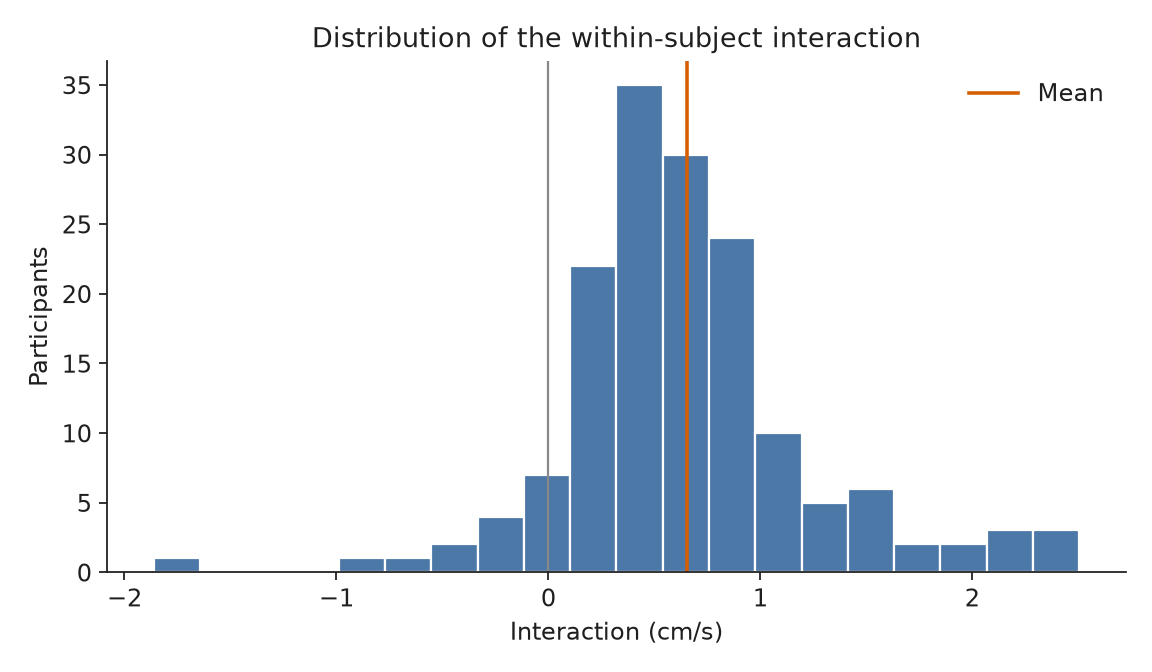
Closing the eyes added 0.65 cm/s more mean COP velocity on foam than on a firm surface (95% CI 0.56 to 0.75; p < 0.001).
Original figures from the reproducible analysis
Published cases
Each published case in this collection keeps its own question, sample and limits.
Context
Quiet stance is a common balance measurement. A person stands still and a force platform records the center of pressure. Closing the eyes, and replacing a firm surface with foam, changes the speed of that path. This case uses the public Human Balance Evaluation Database to estimate those changes inside the same person.
Problem
In adults who completed the four quiet-stance conditions, how much does resultant center-of-pressure mean velocity change when the eyes are closed and when a firm surface is replaced by foam, and is the effect of closing the eyes larger on foam than on the firm surface? The secondary question, using the age groups supplied with the database, is whether those within-person changes differ between adults younger than 60 years and adults aged 60 years or older.
My role
Independent analysis of the public database: file checks, center-of-pressure velocity, participant-level contrasts, uncertainty and the figures on this page. Santos and Duarte collected the measurements and are cited separately.
What I built
Recordings are 60 s at 100 Hz and were already smoothed by the source study with a 10 Hz, 4th order, zero-lag Butterworth filter. This analysis does not filter them again. Resultant mean velocity is the center-of-pressure path length divided by 59.99 s. The primary analysis keeps participants with a valid trial in every condition. Each person then contributes the mean of three repetitions in that condition. Intervals are a percentile bootstrap over those participants (10,000 draws) and a sign-flip test (20,000 permutations), with master seed 2648. The 1,930 stored trials are not treated as 1,930 independent people.
Data or evidence used
Closing the eyes added 0.65 cm/s more mean COP velocity on foam than on a firm surface (95% CI 0.56 to 0.75; p < 0.001). The interaction was positive in 145 of 158 participants. Participant-level condition means, in cm/s, were firm with eyes open 0.99 (0.93 to 1.05), firm with eyes closed 1.09 (1.02 to 1.17), foam with eyes open 2.95 (2.81 to 3.11) and foam with eyes closed 3.71 (3.52 to 3.90). Closing the eyes on the firm surface added 0.10 cm/s (0.06 to 0.14). On foam it added 0.75 cm/s (0.66 to 0.85). Foam minus firm was 1.96 cm/s (1.84 to 2.08) with eyes open and 2.61 cm/s (2.47 to 2.76) with eyes closed. Age was secondary: 86 adults younger than 60 years and 72 aged 60 or older. The interaction, older minus younger, was -0.05 cm/s (95% CI -0.25 to 0.14), p = 0.572. Averaging within the person is what makes that interval honest. The 158 interaction contrasts had a standard deviation of 0.601 cm/s, so the standard error across participants is 0.048 cm/s. Treating the 1,896 trials as if each were another person would shrink it to 0.014 cm/s. Within a condition, the ICC of resultant mean velocity ranged from 0.79 to 0.91, so the repetitions are not independent people. The bootstrap standard error was 0.047 cm/s, in line with the participant-level calculation.
Limitations
158 of 163 recruited participants completed all four conditions. Five did not, 1 younger than 60 and 4 aged 60 or older, so the gaps sit mainly in the older group. Santos and Duarte state that those trials are missing because the person could not complete 60 s. Missing trials were not imputed. The sample is a convenience sample from one laboratory and one examiner, with 114 women and 44 men. The older group has 58 women and 14 men, so the age comparison is not balanced by sex. The estimates are not normative reference values. Quiet-stance velocity is not balance during gait, sport, or a perturbation. Twelve analytic participants carry the source disability flag, kept only as yes or no. Free-text health descriptions are not read or shown. Excluding that flag left the interaction at 0.67 cm/s (95% CI 0.59 to 0.77).
Next validation step
Rerun the contrasts from the public code, keeping the participant as the unit and age as a secondary comparison. This cohort does not set a diagnostic cutoff or a coaching prescription.
Source data and published analysis
- Santos DA, Duarte M. A public data set of human balance evaluations. PeerJ. 2016;4:e2648. ↗
Data paper. It describes the protocol, the age groups and the trials that could not be completed.
- Santos DA, Duarte M. Human Balance Evaluation Database (version 1.0.0). PhysioNet. 2016. ↗
Versioned public database, DOI 10.13026/C2WW2W. The license page served with version 1.0.0 is the Open Data Commons Attribution License. The 2016 paper instead describes the PhysioNet copy as ODC Public Domain Dedication and License. This page follows the license served with the files and does not redistribute the recordings.
- Open Data Commons Attribution License (ODC-By) v1.0. ↗
License followed for the database. It does not relicense the recordings into this portfolio. The analysis writing and figure design are CC BY 4.0.
- Prieto TE, Myklebust JB, Hoffmann RG, Lovett EG, Myklebust BM. Measures of postural steadiness: differences between healthy young and elderly adults. IEEE Transactions on Biomedical Engineering. 1996;43(9):956-966. ↗
Measurement definitions followed for the center-of-pressure summaries.
- Duarte M, Freitas SMSF. Revision of posturography based on force plate for balance evaluation. Brazilian Journal of Physical Therapy. 2010;14(3):183-192. ↗
Methods reference for force-plate posturography used in the analysis.
- Goldberger AL, et al. PhysioBank, PhysioToolkit, and PhysioNet: components of a new research resource for complex physiologic signals. Circulation. 2000;101(23):e215-e220. ↗
Platform citation requested with PhysioNet records.
- Pollard T, et al. PhysioNet as a global platform for biomedical research. Nature Health. 2026;1(8):792-795. ↗
Current platform citation listed with the PhysioNet record.
- Gómez López, V. A. (2026). Vision, support surface, and age in quiet-stance postural sway. Analysis notebook. ↗
Executed narrative notebook in the public repository.