Running Injury Clinic
Running biomechanics & current injury phenotyping
A reproducible audit of a public running-kinematics dataset, with a 30-person engineering pilot and a metadata-only review of repeated-record label variability. A 2026 paper already reports cross-sectional classification on this source, so this project focuses on cohort and temporal-definition readiness. It preserves source-defined summaries and keeps official event/cycle validation as an explicit gate.
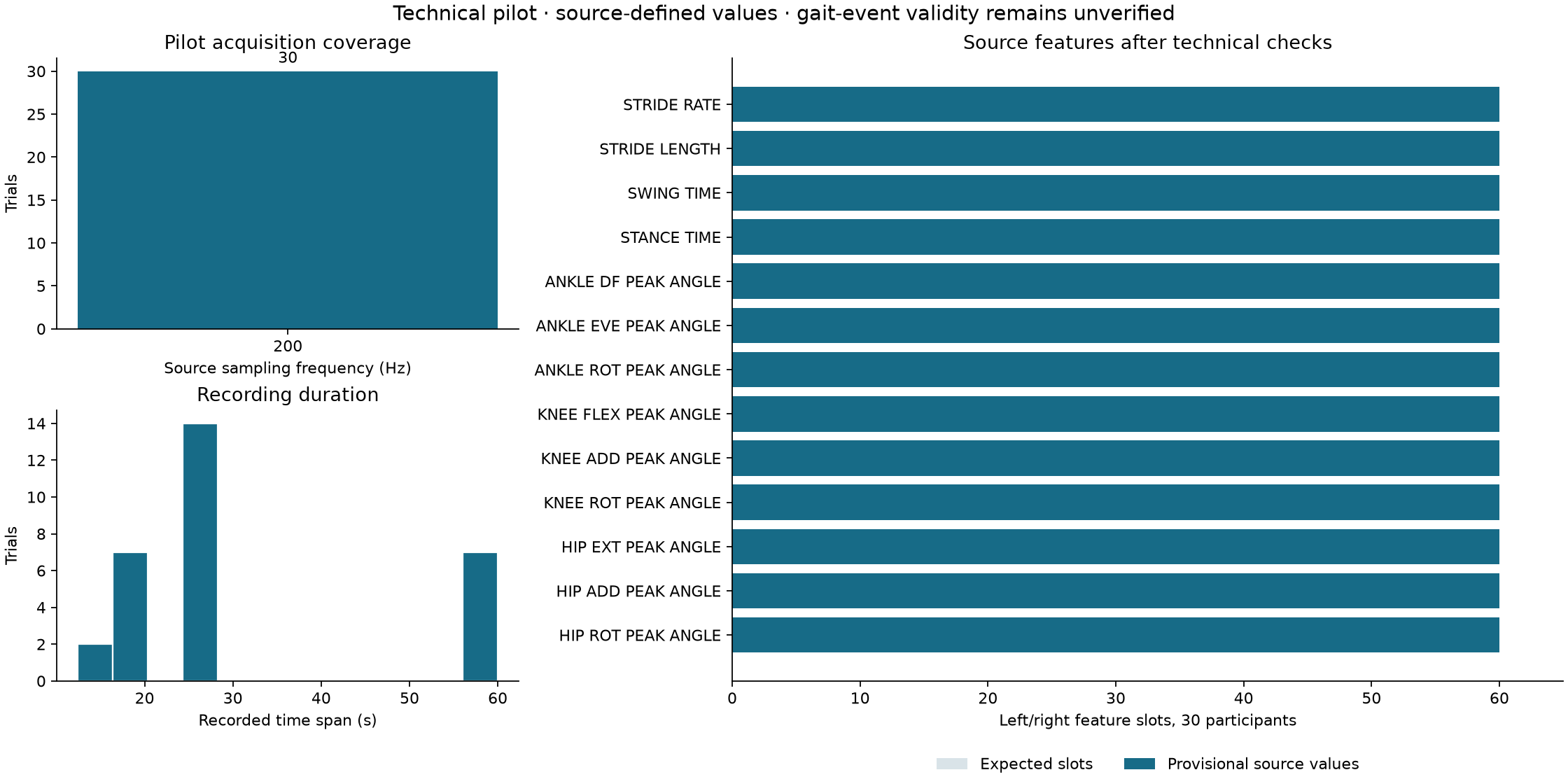
Original figures from the reproducible analysis
What is implemented today
- Trace versioned public-source files and checksums without copying the raw archive into GitHub.
- Inspect participant-level cohort rules, missingness and speed balance before biomechanical inference.
- Audit 13 source-defined discrete variables per side while preserving units and original signs.
- Reproduce structural checks and prepare official event/cycle parity outputs for independent review.
Context
Running-related injuries are heterogeneous, and biomechanical associations depend on how injury, population, speed and movement are defined. The public archive makes a transparent re-analysis possible, but its source summaries should not be confused with independently reconstructed gait cycles.
Problem
Before comparing movement patterns, the cohort rules, source feature definitions, units, signs, missingness and official event-processing workflow need to be visible and reproducible. A structural pass alone cannot confirm event timing, normalized cycles or clinical validity.
My role
Independent source review, cohort-readiness audit, fixed pilot selection, JSON integrity checks, feature registry, provenance, documentation, literature synthesis and bilingual public communication. Original measurements and supplied MATLAB code remain attributed to their authors.
What I built
A version-pinned acquisition pipeline, descriptive cohort audits, 30-file technical pilot, 13-feature-per-side registry, official MATLAB event/cycle comparison runner, unit-tested Python workflow, a source-attributed 30-row Kaggle package with identifiers omitted, and a bilingual animated project site. The publication separates passed structural checks from the still-pending event gate.
Data or evidence used
The primary source is Ferber et al.’s Running Injury Clinic Kinematic Dataset v1 (CC BY 4.0) and its 2024 Scientific Data descriptor. The 30 selected files passed structural checks; all 780 selected values are source-provided discrete summaries. A 2026 cross-sectional classifier on the same dataset reports RF ROC-AUC 0.790, sensitivity 0.905 and specificity 0.523. Our 1,402-runner metadata audit found 209 people with repeated records; 21 had multiple recorded injury-status categories, which are not verified clinical transitions.
Limitations
Cross-sectional, self-reported current injury status is not future incidence or a clinician-verified diagnosis. The balanced pilot is not representative. Speed differs descriptively between candidate groups. Event timing, retained cycles and feature parity have not been independently verified because MATLAB/Octave execution is unavailable here. The derived pilot may remain linkable to the public source despite removal of source IDs and filenames. No participant trajectories are redistributed.
Next validation step
Run the fixed 30-file manifest through the supplied MATLAB workflow with required toolboxes, inspect event-method flags and cycle counts, explain scalar discrepancies and preserve logs/hashes. Only then assess whether the usable cohort can be expanded and conduct a prespecified speed-aware, participant-level analysis.
Source data and published analysis
- Ferber, R. et al. (2024). A dataset of running biomechanics and clinical measures of runners with and without running-related injuries. Scientific Data. https://doi.org/10.1038/s41597-024-04011-7 ↗
Dataset descriptor. It is a separate publication from the dataset licence.
- Ferber, R. et al. (2024). Running Injury Clinic Kinematic Dataset, version 1. Figshare. https://doi.org/10.25452/figshare.plus.24255795.v1 ↗
Versioned source used in this project; CC BY 4.0. Derived values are attributed and labelled as selected source summaries.
- Lopes, A. D., Mascarinas, A. & Hespanhol, L. (2023). Are alterations in running biomechanics associated with running injuries? A systematic review with meta-analysis. Brazilian Journal of Physical Therapy, 27(4), 100538. https://doi.org/10.1016/j.bjpt.2023.100538 ↗
Review finding: limited overall evidence and heterogeneous measurement definitions; no universal marker is established.
- Vannatta, C. N., Heinert, B. L. & Kernozek, T. W. (2020). Biomechanical risk factors for running-related injury differ by sample population. Clinical Biomechanics, 75, 104991. https://doi.org/10.1016/j.clinbiomech.2020.104991 ↗
Prospective-study review: reported patterns varied by sex and competition level.
- Orendurff, M. S. et al. (2018). A little bit faster: lower extremity joint kinematics and kinetics as recreational runners achieve faster speeds. Journal of Biomechanics, 71, 167–175. https://doi.org/10.1016/j.jbiomech.2018.02.010 ↗
Experimental speed changes affected peak lower-limb kinematics and kinetics, supporting speed-aware comparisons.